
Why fireplaces smoke
Two forces, inside and outside the building
A chimney drafts when hot flue gas is lighter than the air around it. Anything that pulls against that lift, inside the building or outside it, can turn the flow around and send smoke into the room.
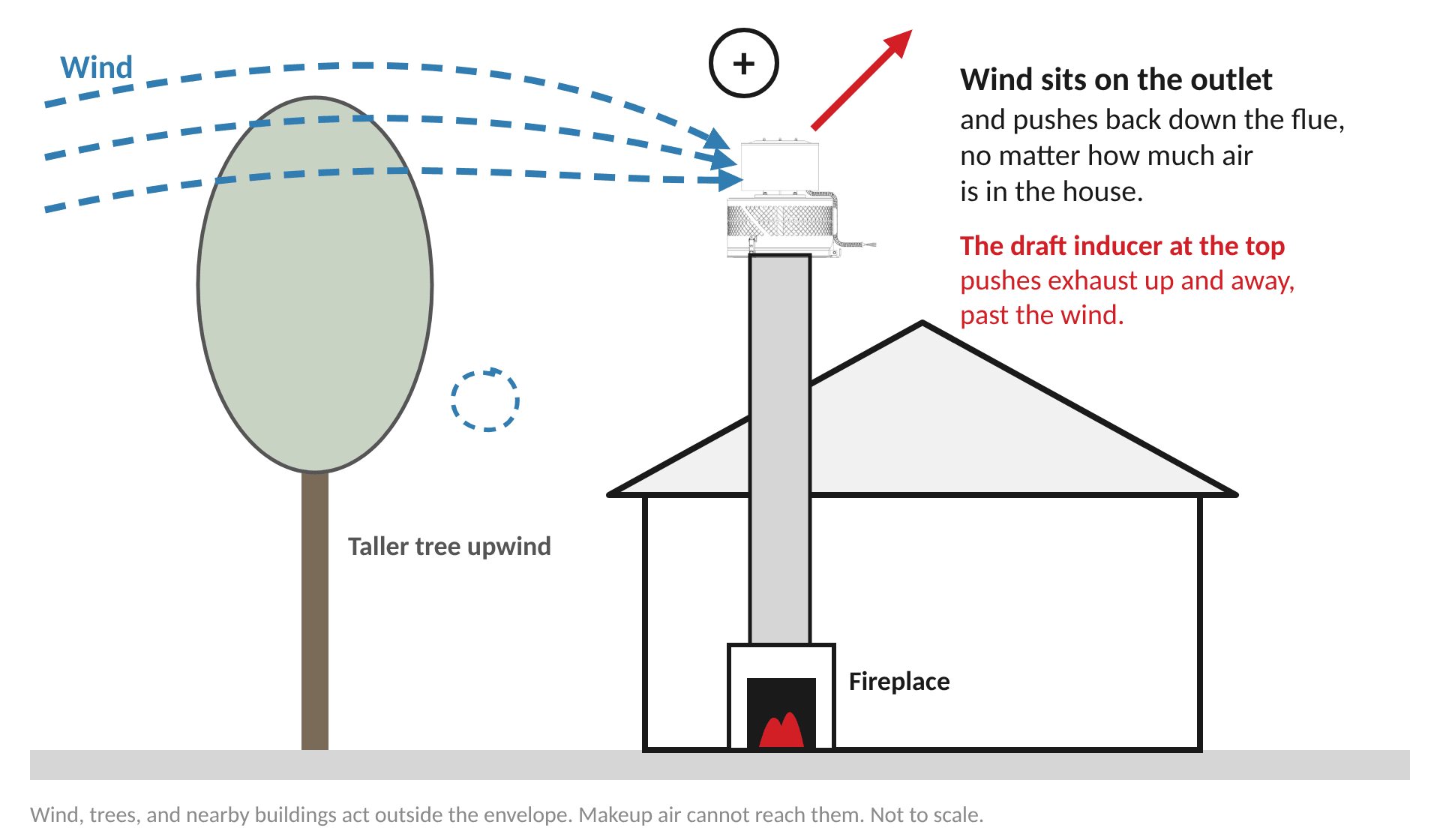
- Exhaust
- Range hoods and dryers
- Wind
- Downdraft at the outlet
- Cold start
- A few Pa of lift
- Tight houses
- Less air to give
- Stack effect
- Low floors run negative
How a chimney drafts
A few Pascals of lift.
Hot flue gas rises because it is lighter than the cooler air outside, and that difference pulls room air into the fireplace and up the flue. On a warm, running fire the pull is strong.
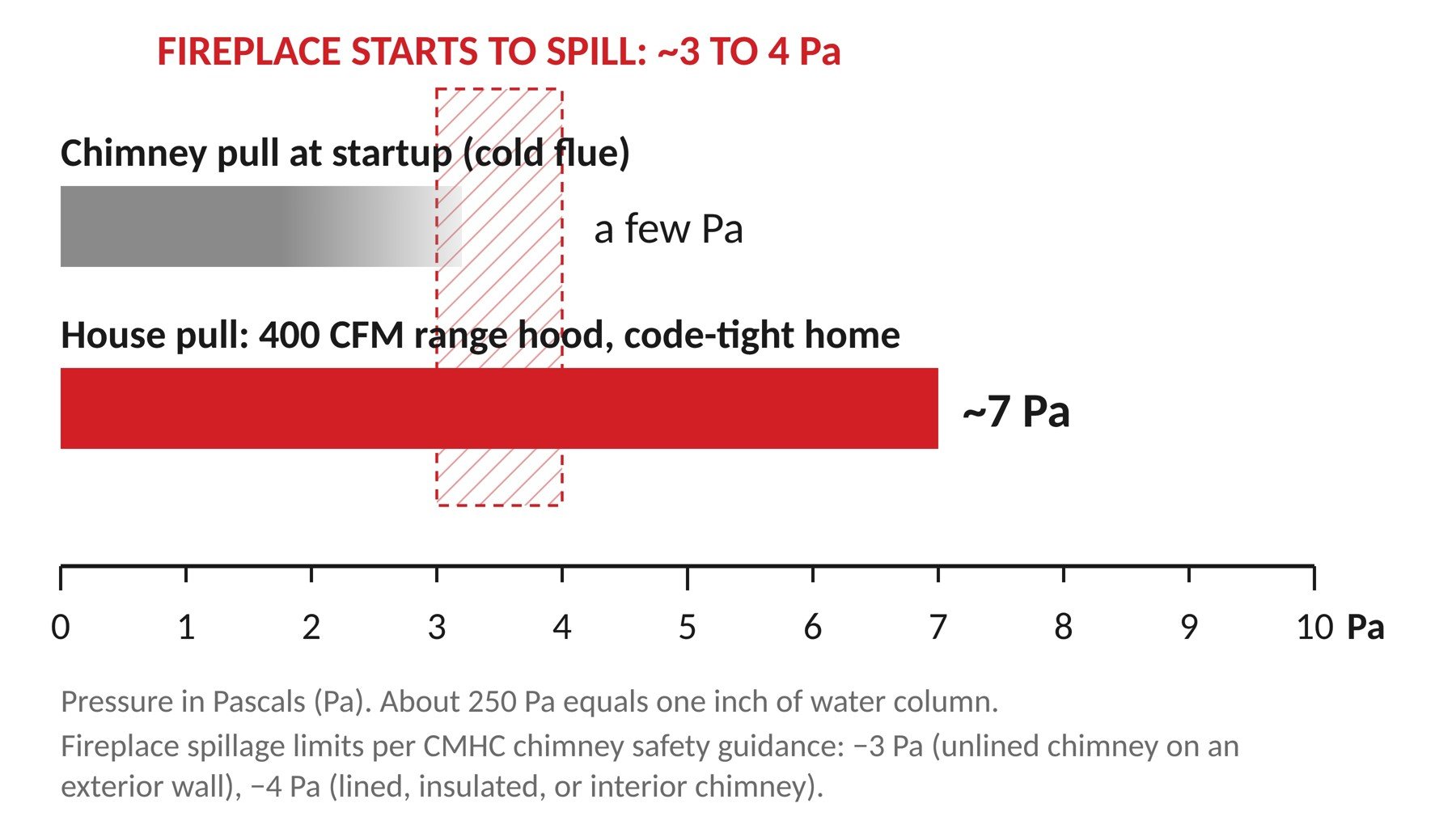
At a cold start, before the flue warms, and again as the fire dies down, the pull can drop to just a few Pascals. An open fireplace can begin to spill at 3 to 4 Pa. That thin margin is what the two forces below take away.
Inside the building
The house pulls back.

Stack effect
Low Floors Run Negative
In winter a heated house acts like a chimney of its own: warm air leaks out up high and pulls air in down low. A basement or ground-floor fireplace starts the evening on the negative side.
Exhaust
Fans Pull the House
Range hoods, dryers, and bath fans pull air out. A 400 CFM range hood alone can pull a tight house ~7 to 8 Pa negative, more than twice what makes an open fireplace spill.
Tight construction
Less Air to Give
Modern codes make houses tighter every cycle, so the same exhaust pulls a newer house harder.
Room to room
See-Through Fireplaces
Two rooms rarely sit at the same pressure. An HVAC return, a bath fan, or a closed door on one side pushes smoke out the other. Two open sides also give the same flue more opening to hold.
The code knows it. NFPA 211 calls for a mechanical draft system to be tested with the other exhaust equipment running, so that it does not cause any other appliance in the house to spill (NFPA 211-2019, 4.1.2.2 to 4.1.2.4).
Outside the building
The wind pushes down.
Wind can sit on top of a chimney like a cap. When air flowing over and around the building pushes down on the outlet, it pushes back down the flue, and no amount of air in the house can reach it. It happens outside the envelope.
It is often occasional, which is what makes it so frustrating: a fireplace that works most nights and smokes on others, depending on the wind.
Trees
They Keep Growing
A fireplace that worked for years can start to smoke as nearby trees grow taller than the chimney.
Buildings
The House Next Door
A new, taller building on the next lot changes how the wind moves across your roof.
Terrain
Valleys and Hillsides
Homes in valleys, on slopes, and in the mountains see downdrafts and still, heavy air.
Direction
One Wind, One Night
Oceanfront, lakefront, and open sites often smoke only when the wind blows from one direction.
Perfect conditions
Natural draft needs perfect conditions.
A chimney can draft on its own when two things are true: the pressure inside the building is neutral or positive, and nothing outside is pushing down or across the top of the chimney.
Inside, we can design for. Outside changes with every gust, every season, every tree that grows and every building that goes up next door. Nobody can promise what the wind will do.
A fireplace is tested for its listing in a lab: still air, a neutral room, and a chimney built exactly to the instructions. That proves the fireplace can draft. It does not promise the house, the roof, or the wind will cooperate.
You might not need a draft inducer. But no one can tell you that ahead of time, including us.
A draft inducer is how a fireplace stops depending on the weather.
Submit plansThe fix
Answer both forces.
Inside
Give the House Its Air Back
VMASS replaces what exhaust removes and holds the room where the fireplace needs it, so the house stops pulling against the chimney.
Outside
Proven Draft at the Outlet
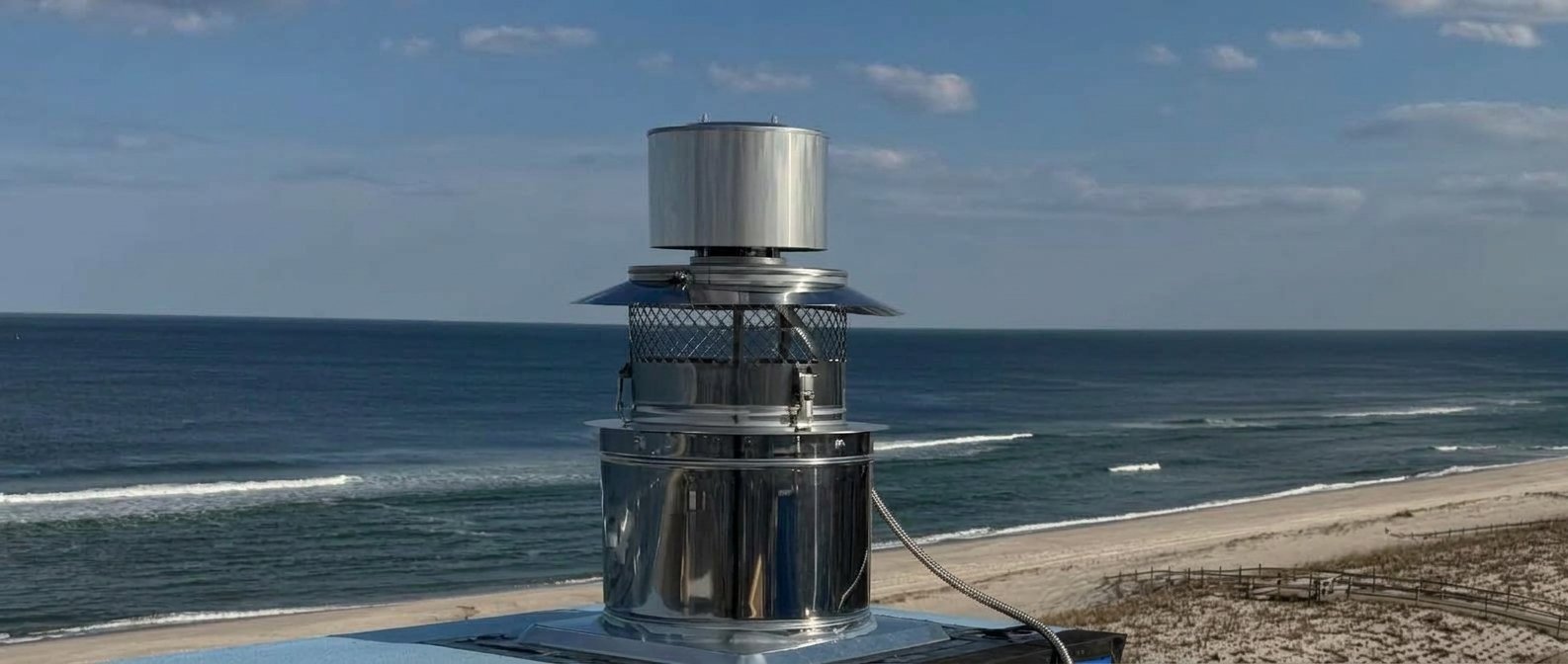
The XV Series draft inducer sits at the outlet and pushes exhaust up and out through the 45° discharge, against the wind. Its controller proves draft: on gas, before the appliance can light; on wood, it alarms if draft is lost. On gas, Meridian senses a draft drop and ramps into its reserve automatically.
Not sure what is working against your chimney? Send the plans, or photos of the chimney and what surrounds it, and we will size the system with you.
Common questions
What people ask us.
- Q.01Why does my fireplace smoke only when it is windy?
- Wind is pushing down on the top of the chimney. Air flowing over the roof, around nearby trees or a taller building, or down a hillside can sit on the outlet like a cap and push smoke back down the flue. A draft inducer at the outlet keeps exhaust moving up and out against the wind.
- Q.02Why does it smoke when the range hood or dryer is running?
- Exhaust pulls the house negative. A 400 CFM range hood can pull a tight house ~7 to 8 Pa negative, and an open fireplace can start to spill at 3 to 4 Pa. Opening a nearby window is a quick test: if the smoke stops, the house needs makeup air. The full story is on The Pressure Problem.
- Q.03Why does it smoke when I first light it?
- A cold flue has almost no lift. Until the flue warms, the pull can be just a few Pascals, and a basement or ground-floor fireplace may start the evening on the negative side of the house. A draft inducer gives the fire full draft from the first match.
- Q.04Will a taller chimney fix it?
- Sometimes, if the problem is wind or a short flue. A taller chimney does nothing for a house that is pulling negative, and it adds cost and height to the roofline. Code already sets a minimum height: 3 ft above where the chimney leaves the roof, and 2 ft higher than anything within 10 ft.
- Q.05Do I need a draft inducer?
- Maybe not. If it smokes only when exhaust is running, start with makeup air. If it smokes with the wind, on cold starts, or on a short or offset flue, a draft inducer gives it draft it can count on. Send photos of the chimney and what surrounds it, and we will tell you what we see.
- Q.06Why is there soot above my gas fireplace?
- A gas fire does not make smoke you can see, so spillage often shows up as soot instead: dark stains on the wall, mantel, or ceiling above the opening. It usually means flue gas is coming back into the room, because the house is pulling negative or the chimney is not drafting. Soot can also come from logs set out of place or a burner that needs service, so have the appliance checked first. If it is set up right and still soots, look at the draft.
- Q.07Is a smoking or sooting fireplace dangerous?
- Smoke or soot in the room means combustion gases are coming in with it, including carbon monoxide. Keep working smoke and CO alarms in the house, have the chimney inspected every year, and do not ignore a fireplace that spills.
- Q.08Why does my house smell like smoke when the fireplace is off?
- Air is coming in down the chimney. When the house runs negative, from exhaust fans, a dryer, or warm air leaking out up high, a cold chimney becomes an air inlet and carries the smell of old soot and creosote into the room. It is the same pressure that makes a lit fireplace smoke. A damper that seals when the fireplace is off closes that path; makeup air answers the reason the house is pulling.