
Automation
Home and building automation
Every X-VENTISO controller turns on and off from a simple low-voltage contact. If it can close a contact, it can run the system: a wall switch, a hearth remote, a home automation scene, or a building automation output.
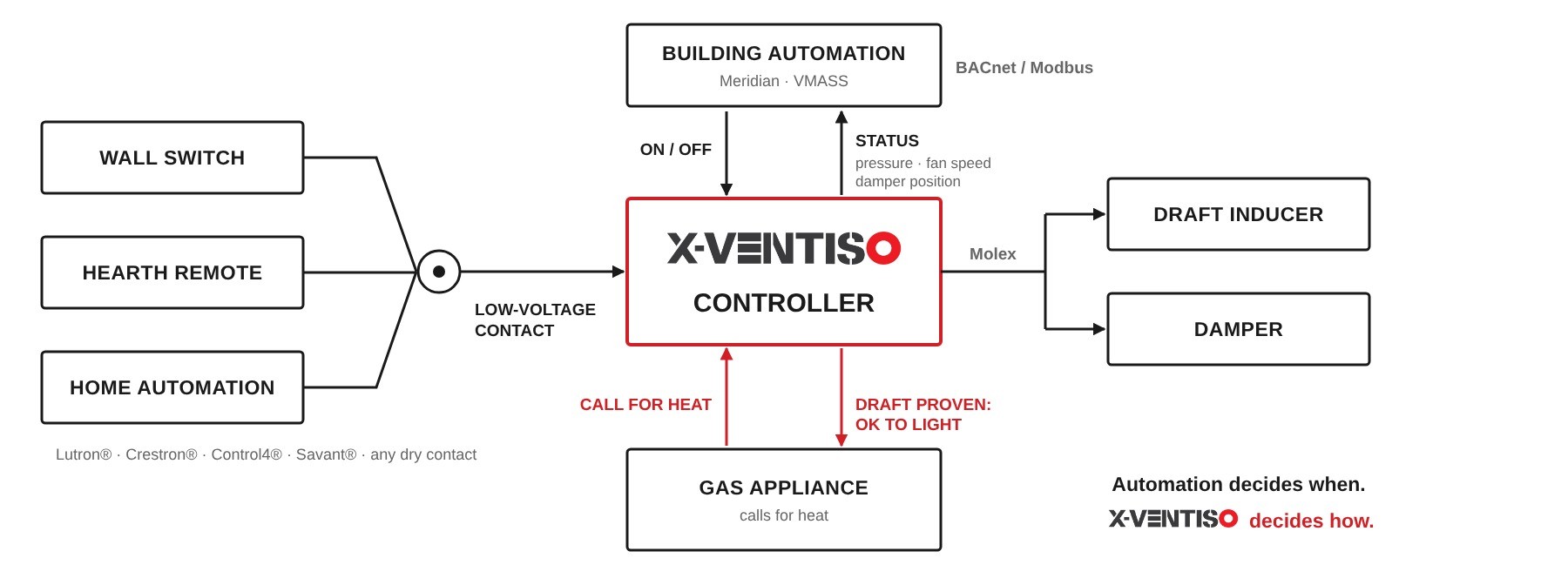
- Input
- One dry contact
- Home
- Lutron · Crestron Control4 · Savant
- Building
- BACnet · Modbus
- Wiring
- Low voltage only
- Safety
- Stays with the controller
One contact
If it can close a contact, it can run the system.
Every X-VENTISO controller has the same on/off input: two low-voltage wires, orange and blue. Join them and the system runs. Open them and it turns off. A wall switch, a hearth remote, a home automation relay, a timer, or a building automation output all do the same thing: close that contact.
That one input is the whole interface for on and off. Nothing on the automation side needs to know about draft, pressure, or the damper. The X-VENTISO controller handles all of it.
Three ways in
Pick the level of control the job needs.
Simple
A Switch or a Remote
A wall switch or a hearth remote on the orange and blue wires. The most common install, and all most homes need.
Home
Home Automation
One button or scene runs the fireplace, the draft inducer, and the makeup air together. Lutron, Crestron, Control4, Savant, or any dry contact.
Building
Building Automation
BACnet or Modbus on Meridian and VMASS, set up at our factory. Status, alarms, pressure, and speed on the BAS.
In the home
One scene, one button.
The fireplace scene
Tie the system into the home's automation, so the fireplace, the draft inducer, and the makeup air come on together from one button, one scene, or one schedule.
X-VENTISO systems are installed with Lutron® and Crestron® controls. Control4® and Savant® systems, and any other system that can close a low-voltage dry contact, run it the same way. On appliances with a SIT Proflame 2 ignition, home automation connects through XV-IGN-PFAK, the Proflame Automation Kit.
One call, every device: XV-INTG
When a fireplace has its own makeup air, both have to start on the same call. XV-INTG takes one low-voltage call and passes it down the line, one controller after another: the draft controller first, VMASS last, and the appliance lights only after every one has answered. It works with every X-VENTISO controller.
One switch, one scene, or one BAS output. Every device follows it, in order, and if one does not answer, the system stops and faults.
In the building
BACnet and Modbus, integrated before it ships.
Meridian and VMASS connect to the building management system over BACnet or Modbus. Facility staff can turn systems on and off and read their status, for one fireplace or every fireplace in the building.
Choose BACnet or Modbus when you order. It ships ready. For BACnet, each controller gets its own XV-BACnet INTF, integrated at our factory, and on site the BAS connects to each one over BACnet/IP with a standard Ethernet cable. For Modbus RTU, we set it up at the factory the same way. Either way, no one opens the controller and there is nothing to configure in the field.
Controlled Power (GBC, WBC, and DUO) connects on and off by dry contact as standard. BACnet or Modbus on Controlled Power is custom, by request.
Need the object list or register map for your integrator? Ask for the points list
| Point | Meridian | VMASS |
|---|---|---|
| On / off | Read and write | Read and write |
| Alarm, including loss of draft | Read | Not available |
| Pressure | Read | Read |
| Draft inducer or fan speed | Read | Read |
| Damper position | Read | Not available |
| Power | Not available | Read |
Relays
Any relay with a dry contact.
The system does not need a full automation platform. Anything with a dry, potential-free contact output can run it: a BAS digital output, a timer, a lighting controller, or a simple smart relay.
For the engineer
Specify a normally open, dry contact, wired across the orange and blue wires of the controller's on/off input. The input is sinking: the controller supplies its own low voltage on that circuit, so the relay supplies none. It only closes the circuit.
| Controller | On/off input | Voltage on the circuit |
|---|---|---|
| Meridian, Meridian DUO, VMASS | Orange and blue wires, sinking | 3.3 VDC, from the controller |
| GBC, WBC, GBC-DUO, WBC-DUO | Orange and blue wires, sinking | 24 VDC, from the controller |
Never apply external voltage to these wires. A contact closure is all it takes: join the two wires, with a lever nut for example, and the system runs. Open, it turns off, exactly as it would from the wall switch.
Proven signal runs up to 300 ft of 18 AWG in commercial environments. Route the signal pair separately from line-voltage conductors. Parallel runs with line voltage can induce noise or voltage on the signal pair and cause intermittent input operation, even with correct wiring and a functioning relay.
For the builder
Want app control without a whole-house automation system? A smart relay with a dry-contact output, on Wi-Fi or Z-Wave, gives the homeowner on and off from a phone, for the cost of a small module.
Wire it where the wall switch would go. Nothing else changes.
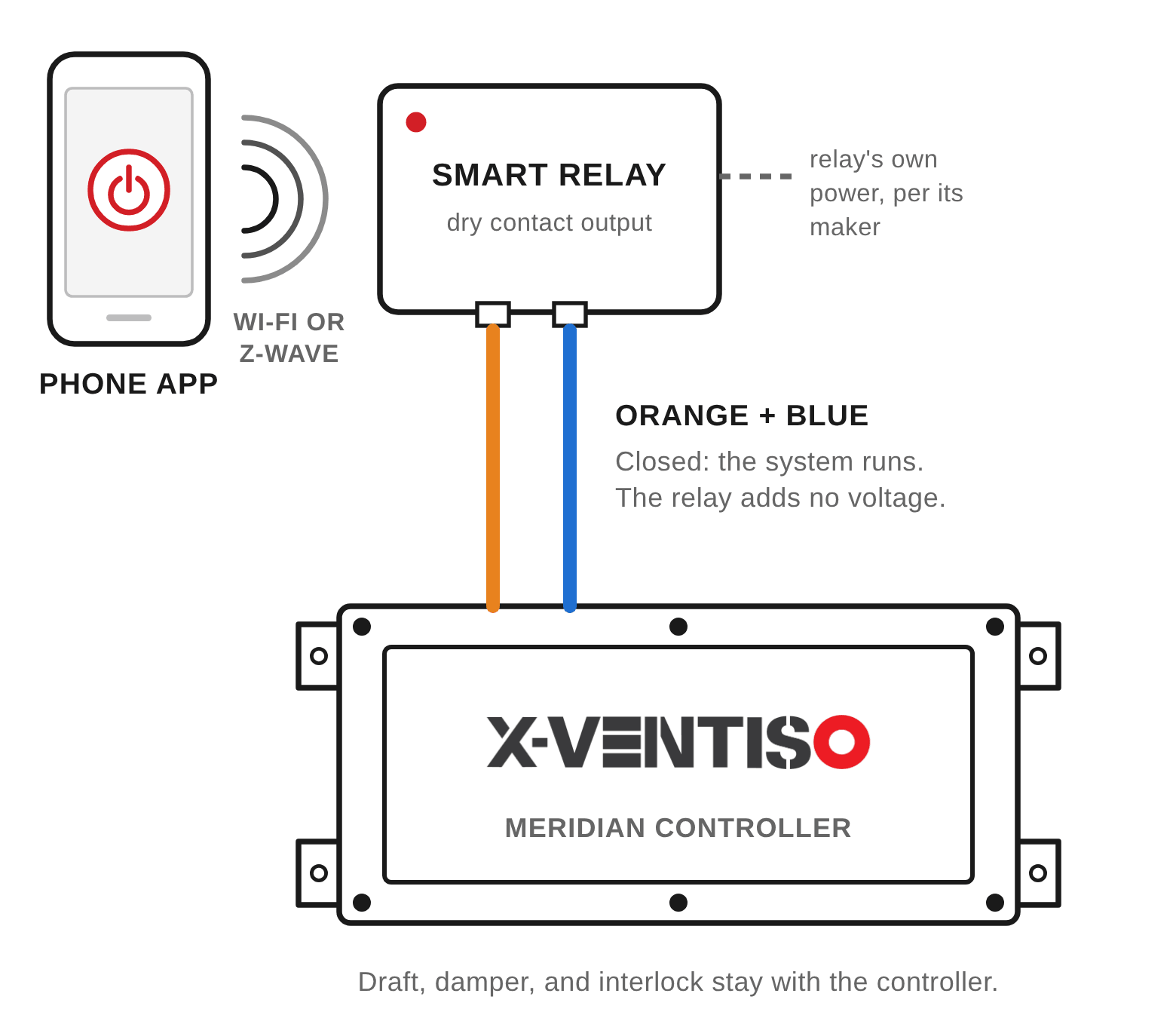
A relay only turns the system on and off. Speed, draft proving, the damper, and the gas interlock stay with the X-VENTISO controller.
Who decides what
Automation decides when. X-VENTISO decides how.
A building or home system can turn an X-VENTISO system on. It never fires the appliance, and it never overrides the safety logic. Commissioned speeds and XV-FLUX targets cannot be changed from a switch, an app, or a BAS.
On a gas appliance, every call runs the same sequence:
The Call
A switch, scene, or BAS output closes the contact.
Draft First
The draft inducer starts and the damper opens.
Proven
The controller proves draft before anything lights.
Then the Fire
The appliance's own control lights it, through the interlock.
If Draft Is Lost
With Meridian: an alarm, the appliance shuts down through the interlock, and the post-purge runs.
What each controller exposes
What each controller exposes.
| Controller | BACnet / Modbus | Automation can | Stays with the controller |
|---|---|---|---|
| XV-MERD-CTRL · XV-MERD-DUO (Meridian) | Yes | Turn the system on and off; read status, alarm, pressure, draft inducer speed, damper position | Firing the appliance |
| XV-VMASS | Yes | Turn on and off; read pressure, fan speed, power | Setpoints (XV-FLUX) |
| XV-GBC | No | On and off by dry contact, standard | Speed and gas interlock. For full BAS integration on gas, specify Meridian. |
| XV-WBC · XV-WBC-DUO | No (custom BACnet / Modbus by request) | On and off by dry contact, standard | Speed, set at commissioning |
| XV-GFDC · XV-SFDC | No | On and off by dry contact | Damper proving and alarm |
Solid fuel damper control (XV-SFDC): keep it out of All Off, Away, Goodnight and scheduled-off scenes. Switching it off closes the damper 30 seconds later, so it should switch off only when the owner turns it off, once the fire and all coals are out.
Common questions
What integrators ask us.
- Q.01Can my fireplace run from Lutron or Crestron?
- Yes. X-VENTISO systems are installed with both. The automation system closes the controller's low-voltage on/off contact, and the X-VENTISO controller handles everything after that.
- Q.02Does it work with Control4 or Savant?
- Yes, the same way. Any system that can close a dry contact can run an X-VENTISO system.
- Q.03Can a cheap smart relay run it?
- Yes. A smart relay with a dry contact output, on Wi-Fi or Z-Wave, gives app control without a whole-house system. Wire it where the wall switch would go.
- Q.04Can automation light the fireplace?
- No. Automation turns the X-VENTISO system on. The appliance's own control lights the fire, and only after the controller proves draft through the interlock.
- Q.05Can the BAS change the draft inducer speed?
- No. Speeds and XV-FLUX targets are set at commissioning and stay with the controller. A BAS can turn the system on and off and read its status.
- Q.06What can a BAS read from Meridian?
- On/off status, alarm status including loss of draft, pressure, draft inducer speed, and damper position, over BACnet or Modbus. On/off is writable.
- Q.07Does anyone open the controller to connect the BAS?
- No. BACnet or Modbus is set up at our factory before the controller ships. For BACnet, each controller's XV-BACnet INTF connects to the BAS over BACnet/IP with an Ethernet cable. The safety logic stays sealed inside the X-VENTISO controller.
- Q.08What voltage is on the on/off wires?
- The controller supplies it: 3.3 VDC on Meridian and VMASS, 24 VDC on GBC and WBC. Never apply external voltage. A contact closure is all it takes.
- Q.09How far can the on/off wiring run?
- Proven runs of up to 300 ft of 18 AWG in commercial environments. Route it separately from line-voltage conductors to prevent induced noise and intermittent input operation.
- Q.10Does Controlled Power speak BACnet?
- Not as standard. GBC and WBC connect on and off by dry contact, which works with any BAS. BACnet or Modbus on Controlled Power is custom, by request.