
Sound and Silencing
Every decision starts with sound
Two types of noise, two different solutions. Size the flue right for air noise. Build and control the system right for mechanical noise.
Two types of noise
Air Noise and Mechanical Noise.
Air noise
Size It Right
Comes from air speed. The fix is flue size and a correctly sized draft inducer.
Mechanical noise
Build It and Control It Right
Starts at the motor and travels down the chimney. The fix is isolation, silencing, and speed control.
Air noise
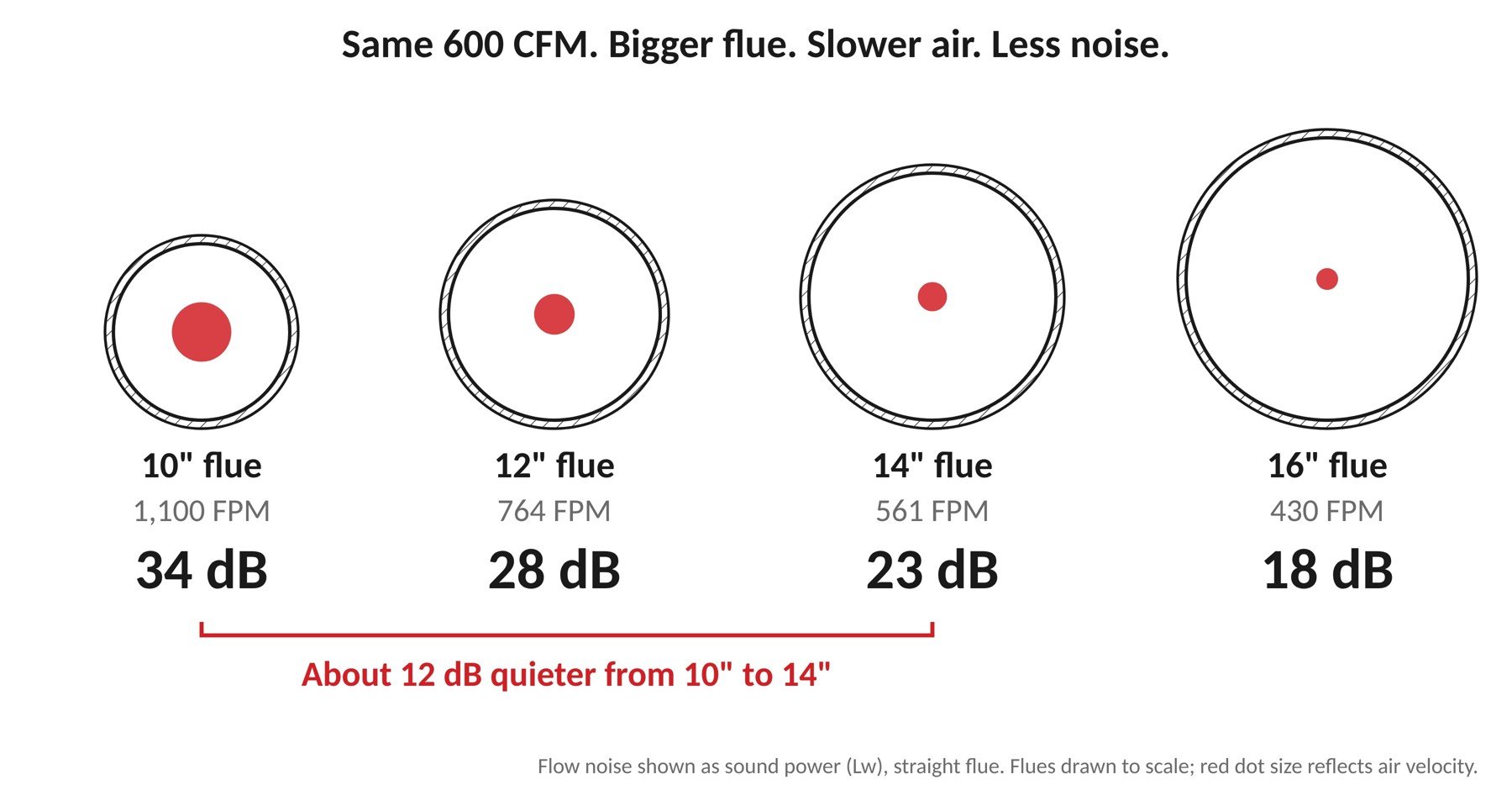
Bigger Flue, Slower Air, Less Noise.
Push the same air through a bigger flue and it moves slower and quieter. Going from a 10" flue to a 14" drops flow noise by ~12 dB.
Flow noise shown as sound power (Lw) in a straight flue, from the empirical straight-duct correlation Lw = 10 + 50 log V + 10 log A.
Mechanical noise
Stop Sound at Every Stage.
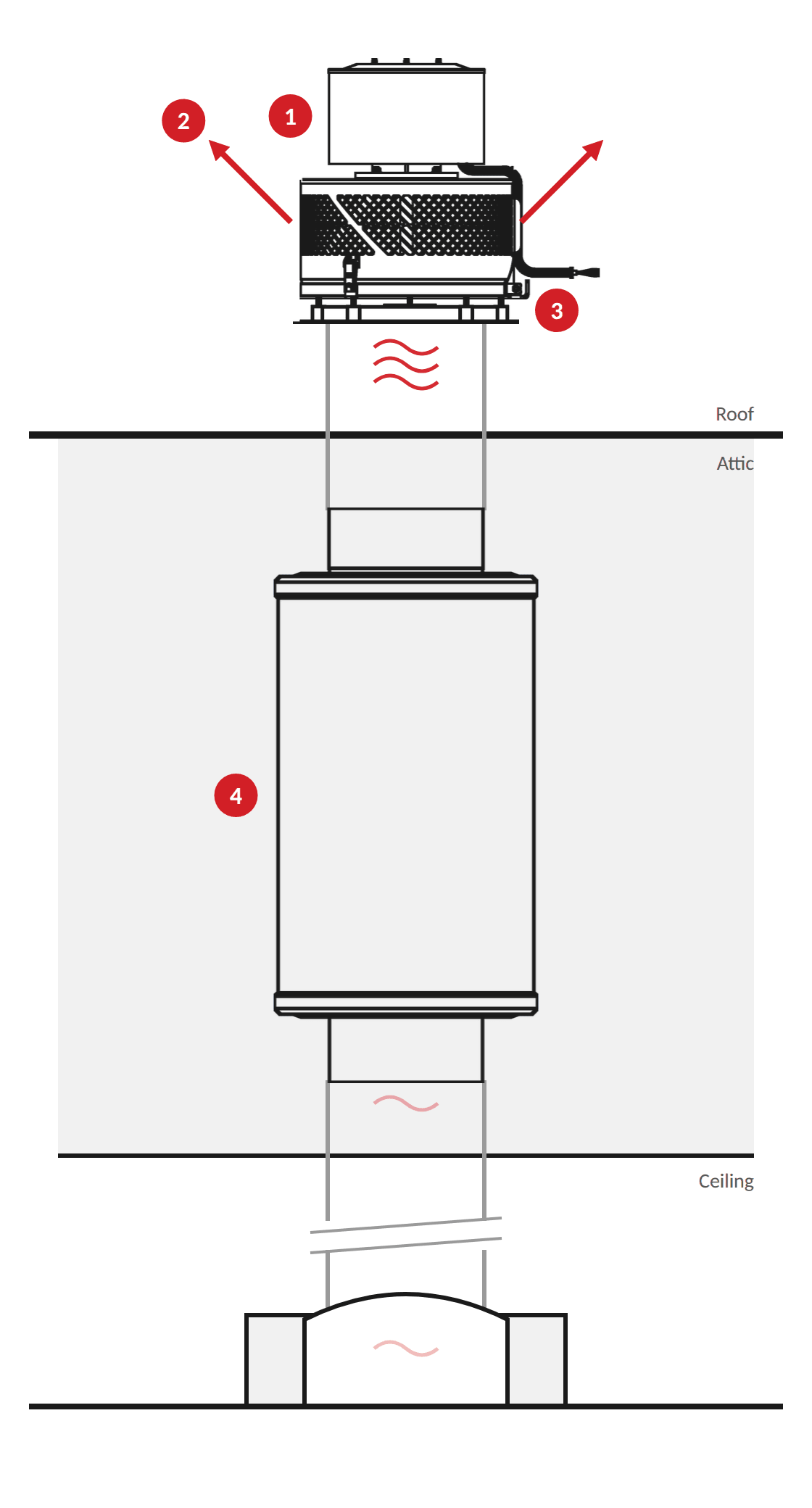
- 01
Draft inducer
Smooth speed control keeps it quiet at partial speed. Curved blades move air smoothly.
- 02
45° upward discharge
Exhaust and sound go up and away from the building, not across the roof.
- 03
Vibration dampener
Isolates the draft inducer from the chimney, so vibration stays at the draft inducer.
- 04
WSPRDraft flue silencer (gas)
Up to 27.5 dB of insertion loss in the mid frequencies, measured at Fraunhofer IBP to ISO 7235. Absorbs mechanical noise before it reaches the room.
Run only as hard as needed
The Quietest Draft Inducer Is the One That Isn't Working Harder Than It Has To.
On gas, Meridian modulates continuously, so the draft inducer runs only as hard as the moment requires. Controlled Power is set at commissioning to exactly what that chimney needs.
Draft inducer sound drops sharply as speed comes down. At 38 V, a typical commissioning setting, XV Series draft inducers tested 23 to 34 dB quieter than full speed. To the ear, every 10 dB drop sounds about half as loud.
Pressure in reserve
Quiet by Default.
XV Series draft inducers are selected with more pull than most chimneys need. We commission them low, where they are quietest, and the reserve is there when it is needed. With Meridian, the system draws on it automatically: a cold start, a windy day, or a house pulling hard. With Controlled Power, it lets the installer set a quiet speed that still drafts a demanding chimney.
What you actually hear
From the Roof to the Room.
Sound is measured at the source: how much sound the draft inducer itself produces. What a person hears depends on where they are.
Outdoors, sound fades with distance. Every doubling of distance takes ~6 dB off, and the upward discharge aims it away from people on the ground.
Indoors, the roof and ceiling block most of it. The path that matters is the flue, which carries sound down to the hearth opening. That is the path the controller, the dampener, and WSPRDraft are built to quiet.
The drop carries through. Every path to a listener starts at the draft inducer, so a drop in sound power at the source is roughly the same drop in what reaches the patio or the room, whatever the building.
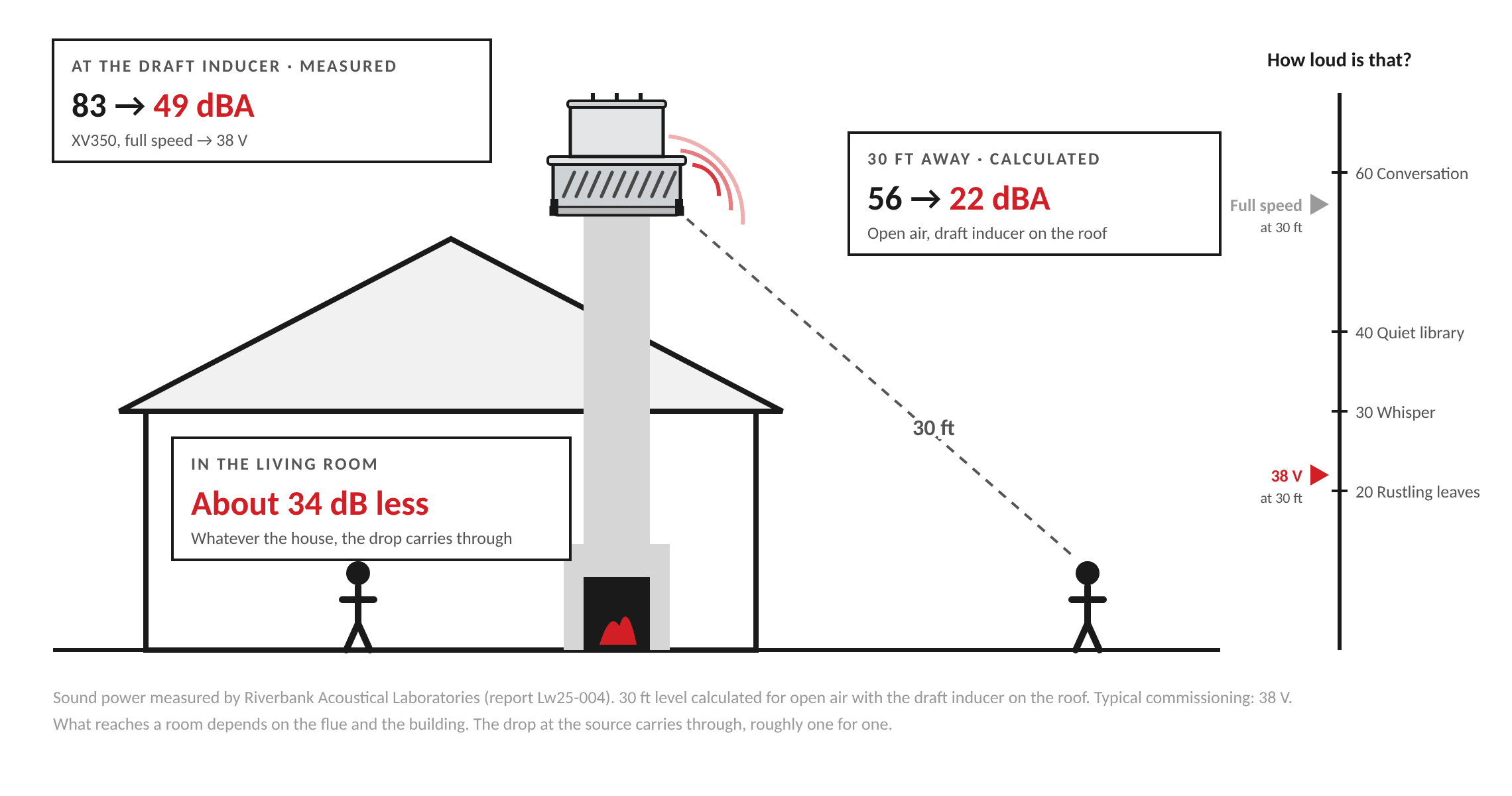
At 38 V, a typical commissioning setting, an XV Series draft inducer tests 23 to 34 dB quieter than at full speed. On gas installs, WSPRDraft takes about another 13 to 19 dB off the sound traveling down the flue at that speed, depending on size (calculated). Every 10 dB of that sounds about half as loud.
The goal is simple: the fire should be the loudest thing in the room.
Reading sound data
Four Questions to Ask About Any Sound Number.
01
Who Measured It?
An independent laboratory, or the manufacturer?
02
To What Standard?
A reverberation room test such as ANSI S12.51 / ISO 3741 measures the sound the product itself produces.
03
Power or Pressure?
Sound power describes the source. Sound pressure depends on distance and the room, and means little without them.
04
At What Speed?
Full speed, or the speed it actually runs once commissioned?
A number with no lab, no standard, and no speed is a description, not a measurement.
We answer all four for our own products, below.
Our numbers
Independently Tested. Published.
We publish our sound data: lab-tested, at the speed the draft inducer actually runs. Here are our answers to the four questions.
Every number below is the draft inducer itself, measured at the source. On a real home, that source sits at the end of the run, usually the top of the chimney, often 30 to 40 feet from the people below, with the roof, the flue, and distance in between. See From the Roof to the Room, above.
We didn't test in our own shop. We took it to labs the building industry already trusts.
Geneva, Illinois
Riverbank Acoustical Laboratories
Built in 1918 for Wallace Clement Sabine, a founder of architectural acoustics. More than a century of measuring sound, accredited by NIST under NVLAP. Tested the XV Series.
Stuttgart, Germany
Fraunhofer Institute for Building Physics
Part of Germany's Fraunhofer-Gesellschaft research organization, with acoustics among its core fields. Tested WSPRDraft.
| XV Series draft inducers | WSPRDraft flue silencers | |
|---|---|---|
| Who measured it? | Riverbank Acoustical Laboratories, independent | Fraunhofer Institute for Building Physics (IBP), independent |
| To what standard? | ANSI S12.51 / ISO 3741, reverberation room (report Lw25-004, 2025) | ISO 7235:2003, insertion loss (report IP-TA 6_2004, 2004) |
| Power or pressure? | Sound power, the source number | Insertion loss: how much sound the silencer removes, by frequency |
| At what speed? | Seven speeds, from full speed down to 38 V, a typical commissioning setting | Measured on the silencer body; applies at any draft inducer speed |
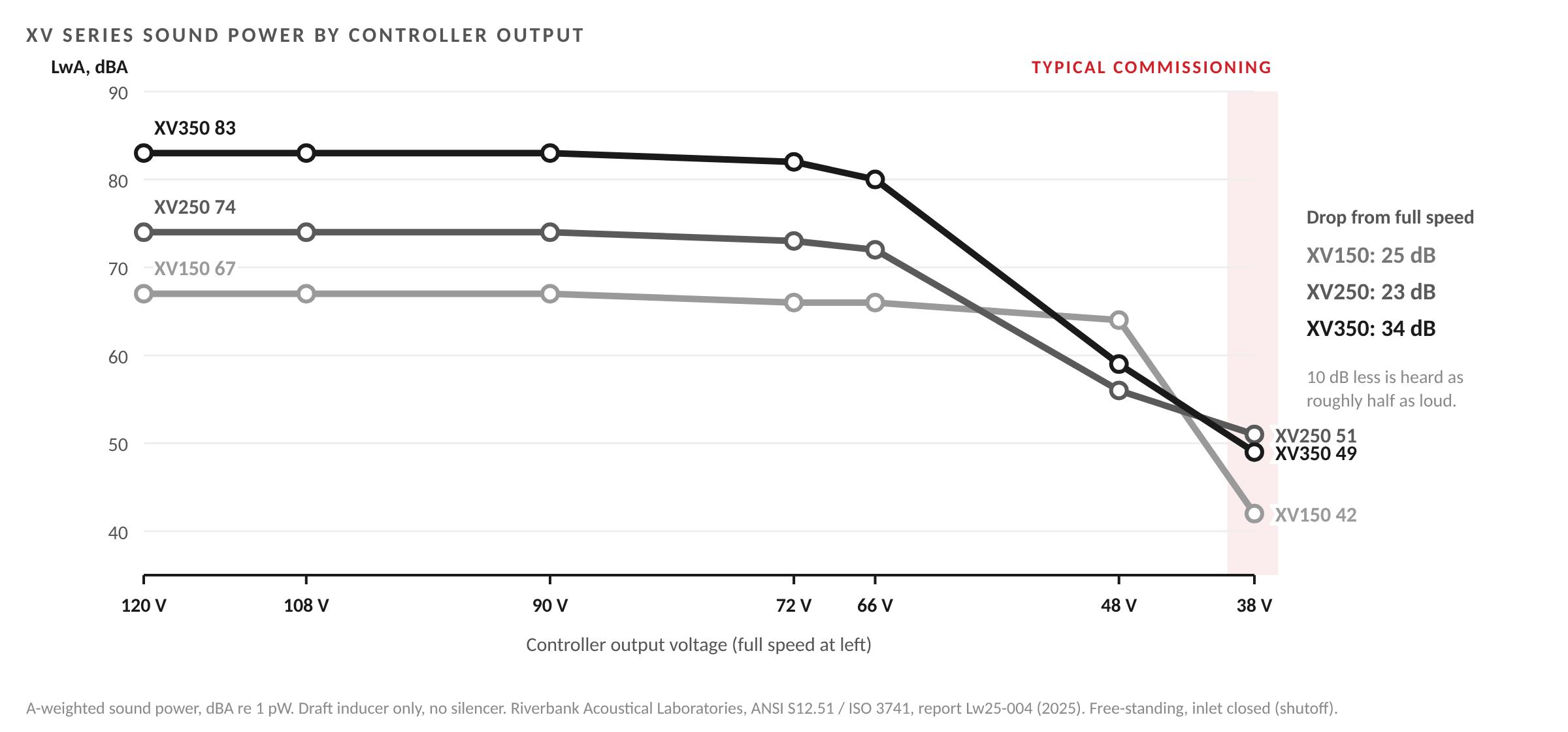
Tested free-standing with the inlet closed (shutoff); full test conditions are on the data sheet. Commissioning speed is set for each chimney. What is heard in a space depends on the flue, the silencer, the building, and distance.