
The pressure problem
Why tight buildings and chimneys fight
Every exhaust appliance pulls on the building envelope. When the building pulls harder than the chimney lifts, the chimney loses.
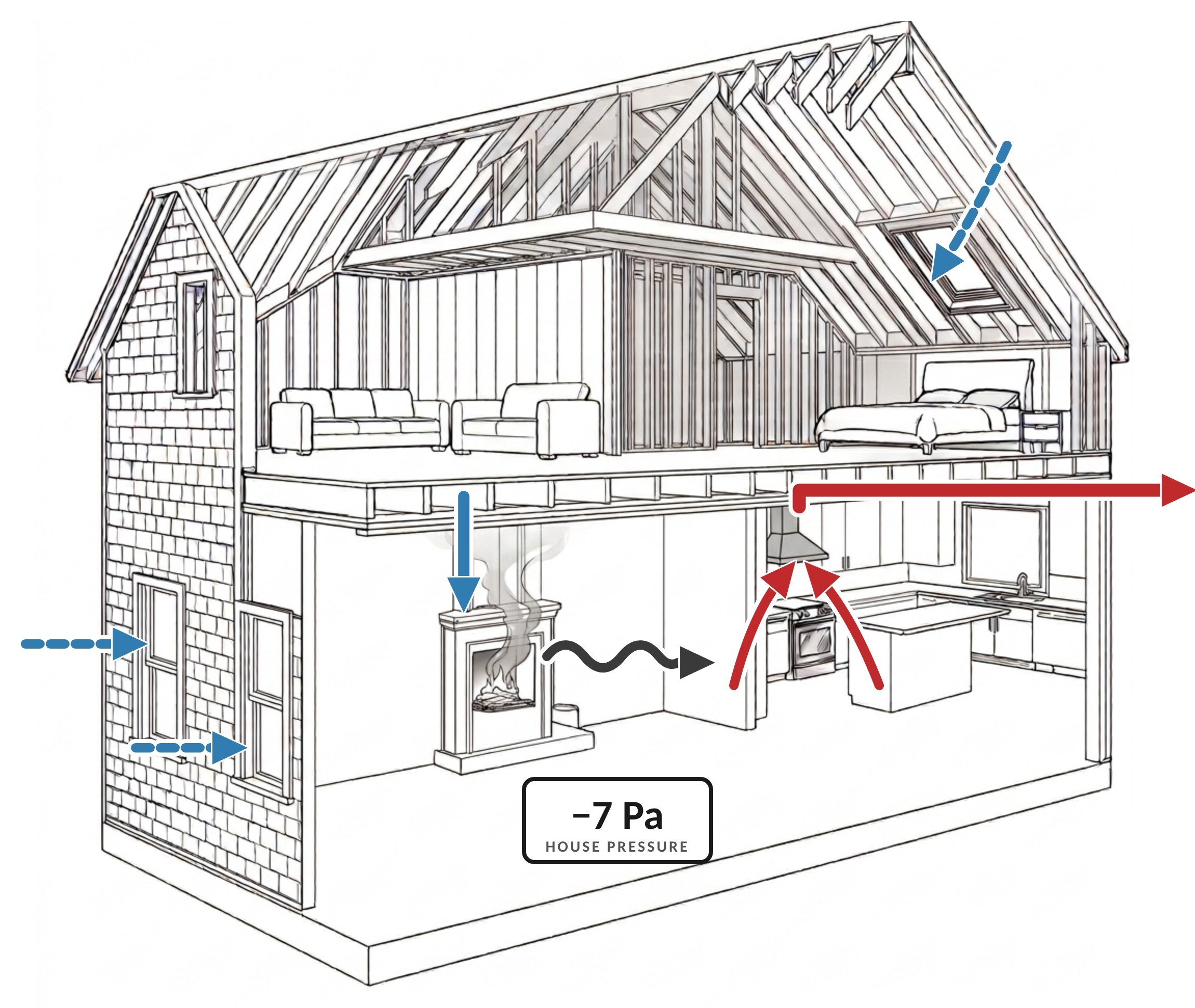
- Mechanical airflow
- Air leakage
- Air pulled in through the flue
- Flue gas spillage
Lungs, not skin
A building should breathe through its lungs.
Older buildings breathed through their skin: air leaked through cracks, gaps around windows, and the attic. Buildings constructed to today's energy codes are sealed tight, so most of that leakage is gone.
The air a building needs now has to come through planned paths: ventilation, makeup air, and combustion air. Every mechanical ventilation system works one of three ways, and each one changes the pressure inside the building.
Fig. 1 Exhaust
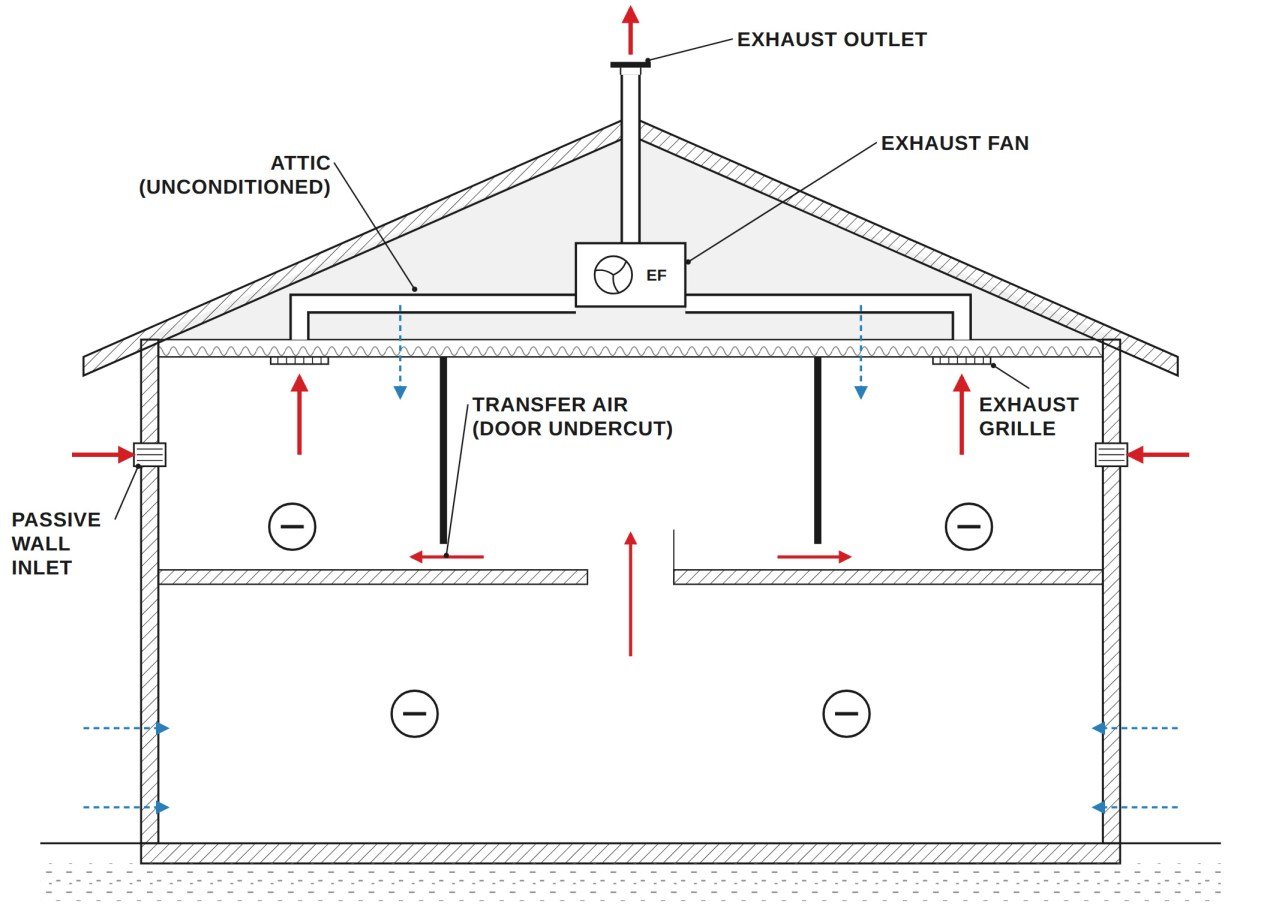
Fans pull air out, and replacement air finds its way back in through passive inlets and leaks. The building runs negative, which works against every chimney in it.
Fig. 2 Supply
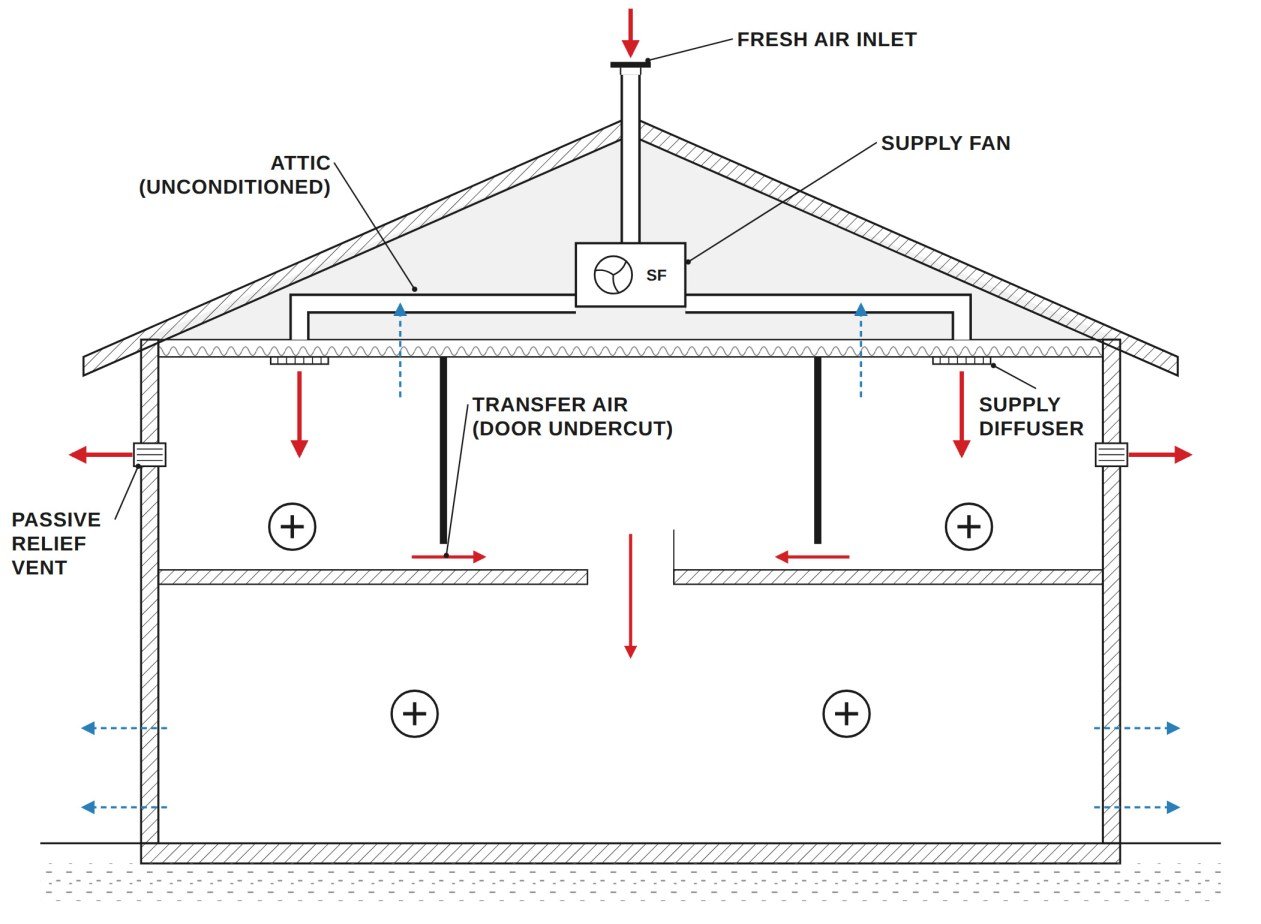
A fan pushes outdoor air in, and indoor air leaves through relief vents and leaks. The building runs slightly positive.
Fig. 3 Balanced
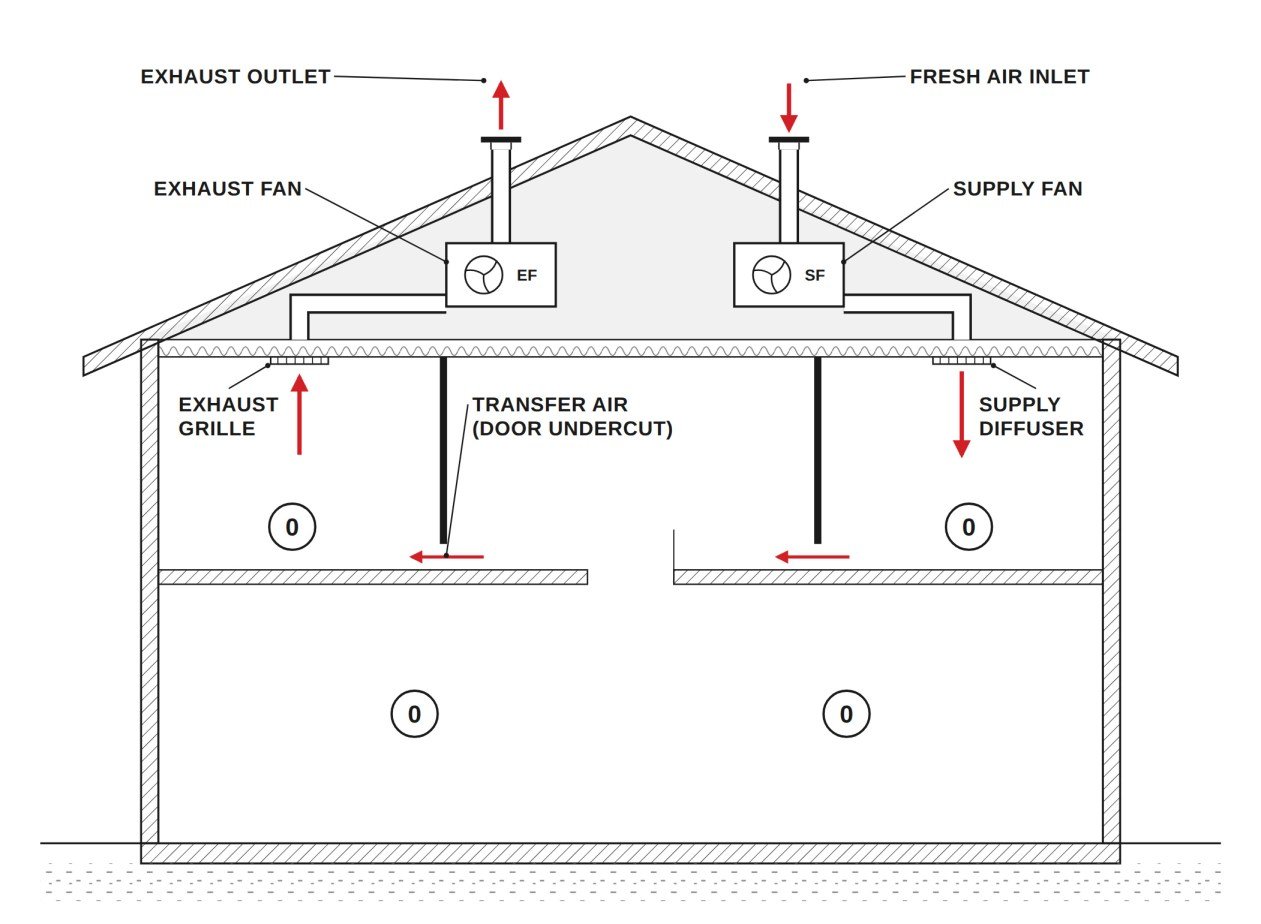
Supply and exhaust move matched airflow, so the building stays near neutral. An ERV balances its own airflow, but cannot respond when a hood or fireplace starts pulling.

Why now
Code made houses tight. Exhaust didn't get smaller.
Energy codes now call for new houses to pass a blower door test. Under recent editions of the International Energy Conservation Code (IECC), the limit is 3 air changes per hour at 50 Pa (3 ACH50) in most of the U.S. The warmest climate zones allowed 5 ACH50 until the 2024 edition cut it to 4, and the coldest zones are now at 2.5. High-performance programs go further: Passive House targets 0.6 ACH50.
Tighter is better for comfort and energy. But the range hood, the dryer, and the fireplace still move the same air they always did. In a leaky building, that air came back through the cracks almost unnoticed. In a tight building, the same hood pulls the whole building negative.
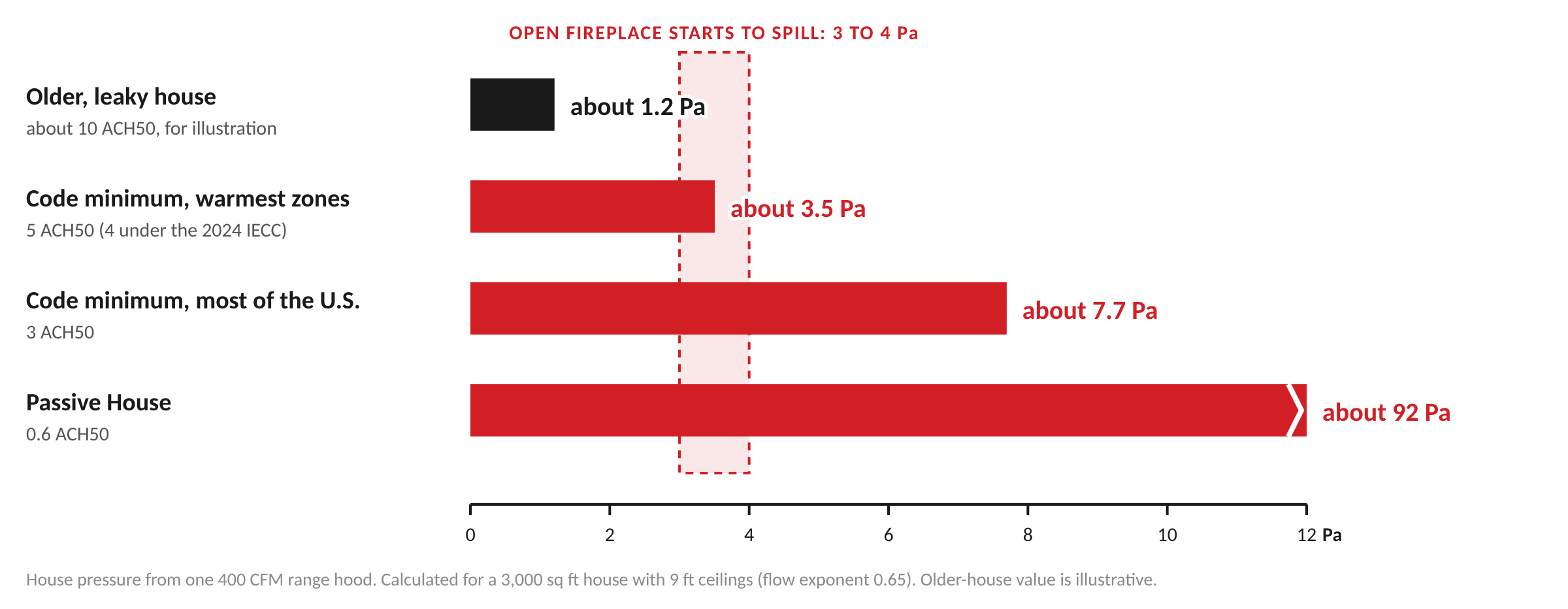
Requirements vary by code edition and jurisdiction. Confirm with the authority having jurisdiction.
Fifty years of energy code in one timeline: How Houses Got TightPressure decides draft
When the building pulls harder than the chimney lifts.
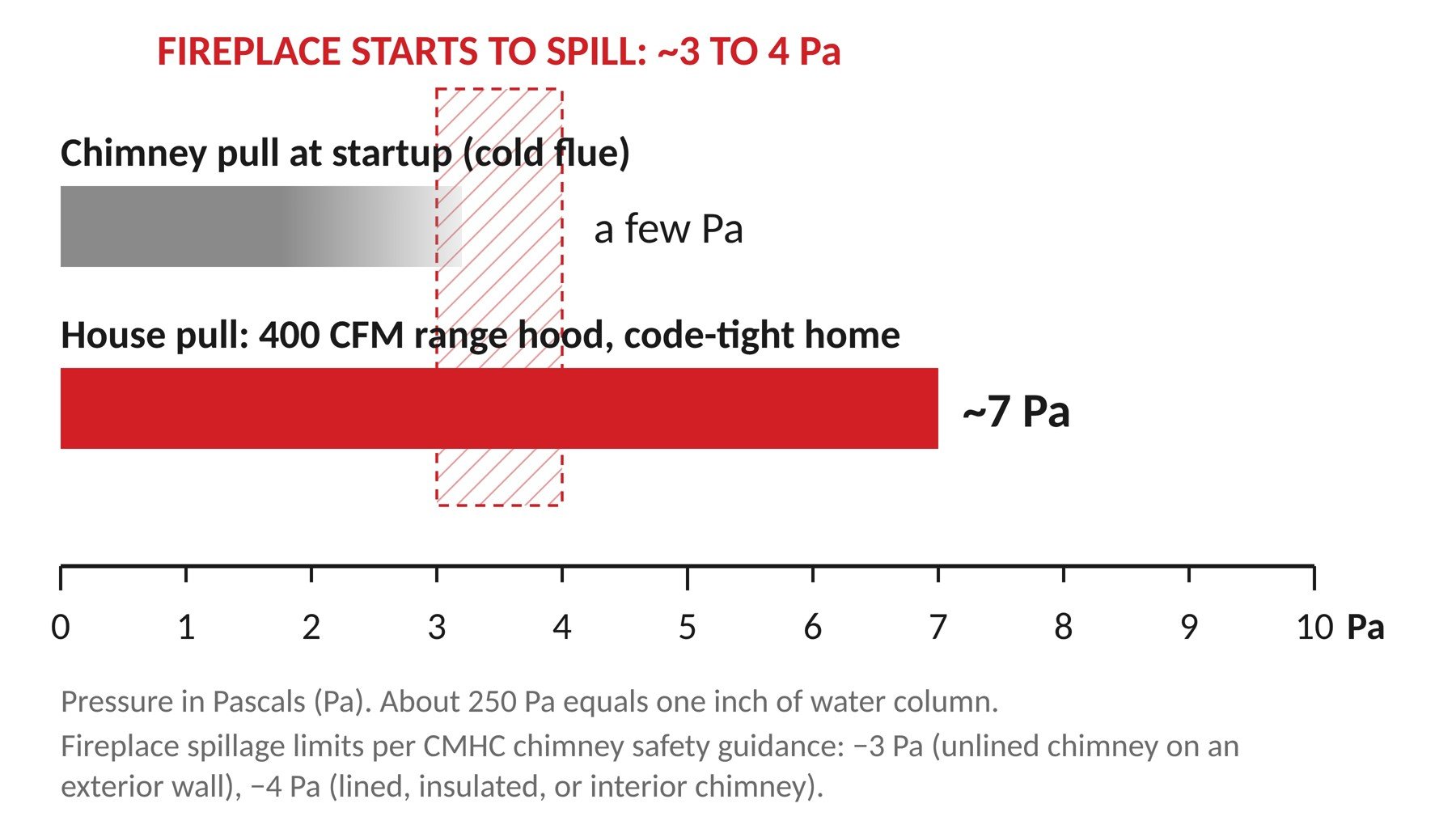
At startup, before the flue warms, and again as the fire dies down, a chimney's pull can drop to just a few Pascals.
In a building constructed to today's energy code, a 400 CFM range hood can pull the envelope negative by roughly 7 to 8 Pa. Combustion-safety guidance puts the point where an open fireplace starts pulling flue gas back into the room at around 3 to 4 Pa.
It adds up.
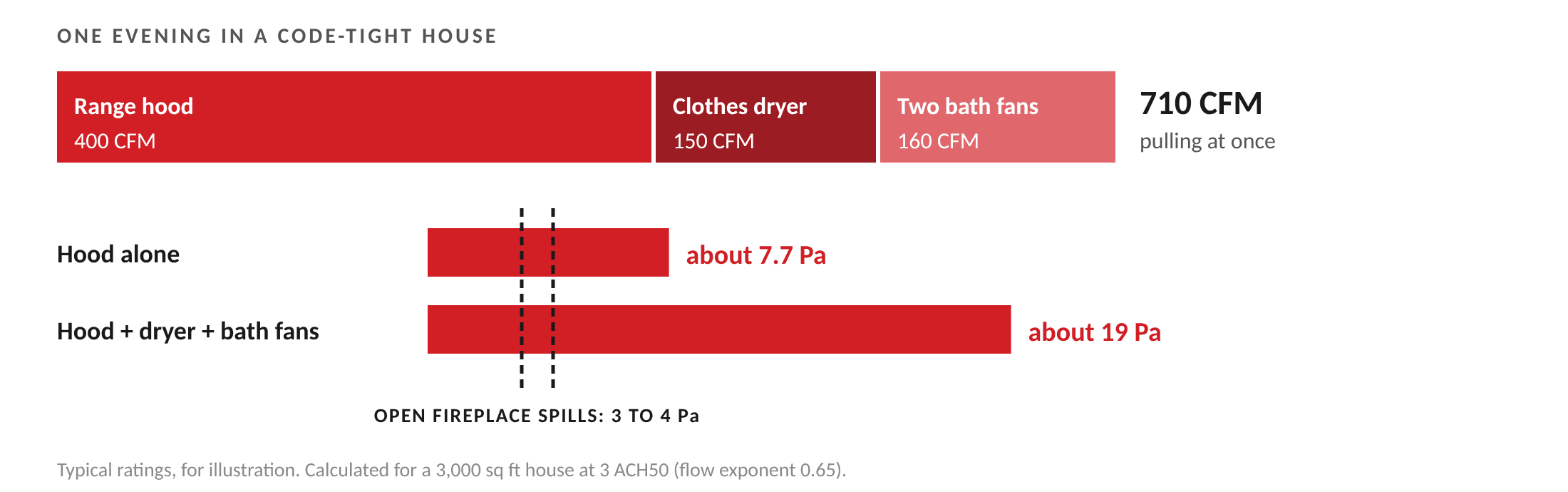
The range hood is rarely alone. A clothes dryer moves around 150 CFM, and bath fans 50 to 100 CFM each. Run them together on a winter evening and the building is pulled well past the point where an open fireplace spills. A second fireplace counts too: the stronger chimney can pull air down the weaker one.
Stack effect
In winter, the building itself becomes a chimney.
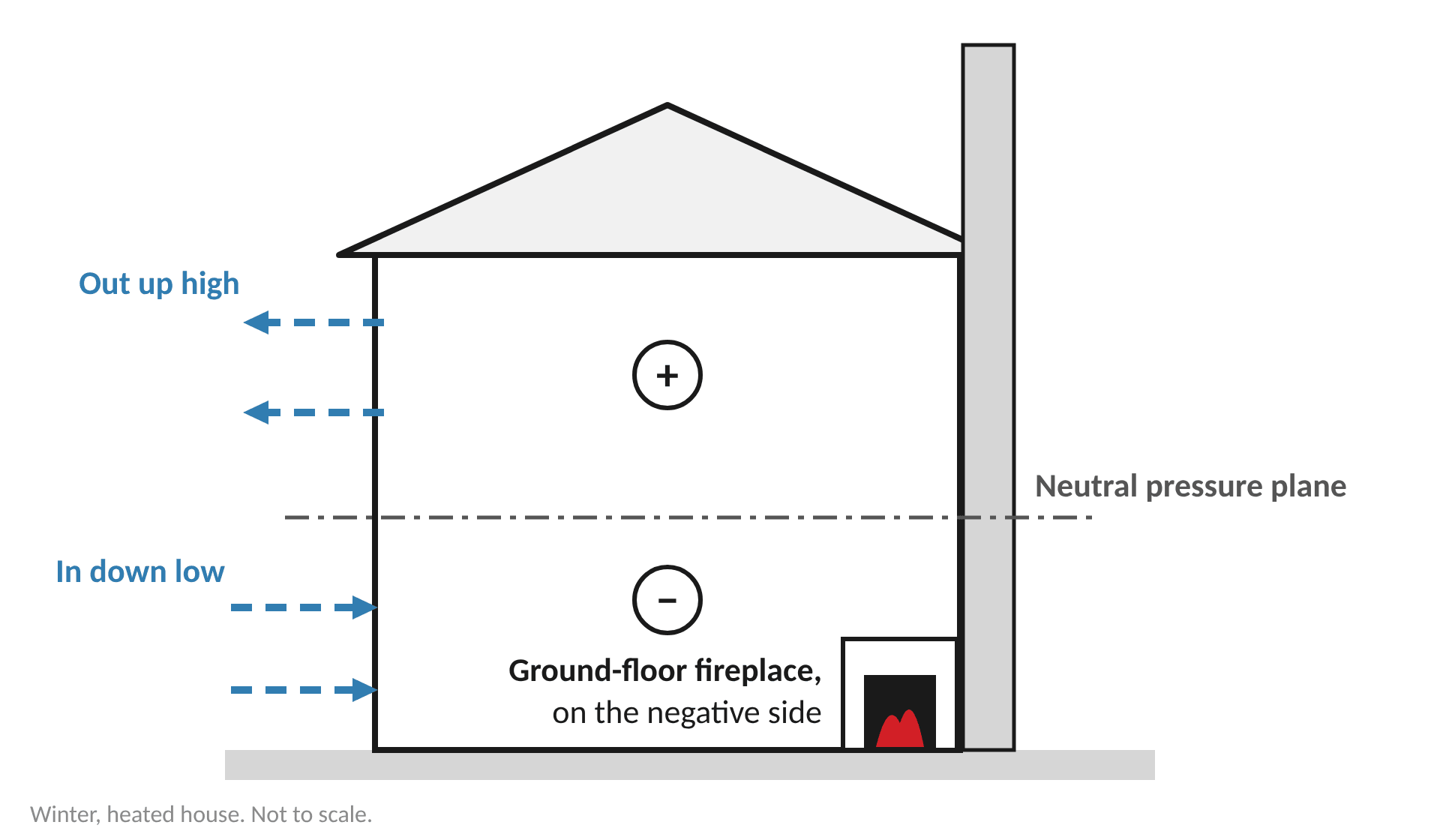
Warm air rises. In a heated building it pushes out through leaks up high and pulls outdoor air in through leaks down low. The level where the two balance is the neutral pressure plane.
Below that line, the building is already negative before a single fan turns on. A fireplace on the ground floor or in a basement starts the evening on the losing side, and the taller the building, the stronger the pull.
A chimney on an exterior wall adds to it. A cold flue has little lift of its own until it warms, which is exactly when the building is pulling hardest.
Signs of a pressure problem
Sound familiar? It may not be the fireplace.
When a fireplace smokes, the fireplace usually gets the blame. In a tight building, the cause is often the pressure around it. These are the signs we hear about most.
01
Smoke at startup
Smoke rolls into the room when the fire is lit, then settles once the flue warms up.
02
Smoke when fans run
The fireplace smokes when the range hood, dryer, or bath fans come on.
03
Smell when it is off
A smoky or sooty odor comes from the fireplace when it is not in use.
04
Soot on the face
Dark staining on the fireplace surround or the mantel above the opening.
05
Cold air falling out
A steady cold draft from the fireplace when it is off.
06
Doors that pull
Doors whistle, pull shut, or are hard to open while exhaust fans are running.
One or two of these in a newer, tighter building usually points to pressure, not the fireplace. Send us the plans and we will tell you which.
Fixes that fall short
Fixes that are not sustainable solutions.
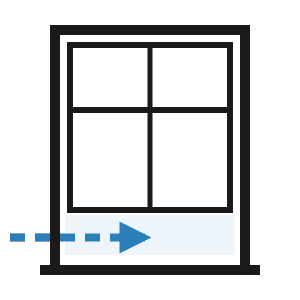
Passive
Opening a window
Only helps when it is open, and it is usually closed in cold weather, when hearth appliances run most.
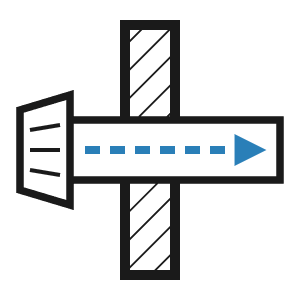
Passive
Outside air kit
A passive opening can limit negative pressure, but cannot prevent it when exhaust appliances start pulling.
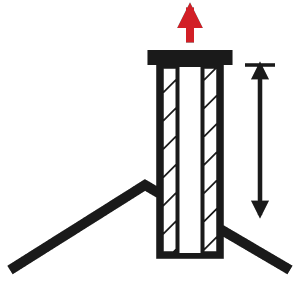
Height
Taller chimney
Stronger pull when the fire is hot. A cold flue at startup gets little benefit from the extra height.
A passive opening only lets air in once the building is already negative. A fan delivers exactly when the pressure drops, as much as the room needs.
Three kinds of air
Three kinds of air. Three different jobs.
| Air | Its job | How much | Who handles it |
|---|---|---|---|
| Ventilation air | Dilutes indoor pollutants for the occupants | A steady rate, set for the building | Your ERV or HRV. VMASS pairs with it. |
| Makeup air | Replaces what exhaust appliances remove | Whatever is running right now | VMASS, sensing the zone it serves |
| Combustion air | Feeds fuel-burning appliances | Small: ~10 cu ft of air per 1,000 BTU | The appliance, with the draft system carrying it up the flue |
Ventilation is designed in. Combustion air is small. Makeup air is the one exhaust forgets.
Who owns the pressure
Four trades touch the pressure. None of them owns it.
HVAC designer
Heating, cooling, ventilation
Sizes the equipment for the building. The hood and the fireplace are often picked later, by someone else.
Kitchen designer
The range hood
Matches the hood to the cooktop. Its CFM is a cooking decision, not a building one.
Hearth dealer
Fireplace and chimney
Sells the appliance and the flue. The building it sits in is already designed.
Builder
The envelope
Seals the building to pass the blower door test, which makes every exhaust count for more.
The code already makes it one problem. NFPA 211 says a mechanical draft system must not cause other combustion equipment in the building to spill, and that it be tested before it goes into service, running together with the other exhaust equipment likely to operate at the same time (NFPA 211-2019, 4.1.2.2 to 4.1.2.4). The hood, the dryer, and the bath fans are part of the chimney test.
One zone, one design, one call. We size the draft and the makeup air together, for the room they share.
The fix
Mechanical draft, with makeup air to match.
Control both sides of the pressure problem: a controlled exhale up the chimney, and a controlled inhale that answers the room.
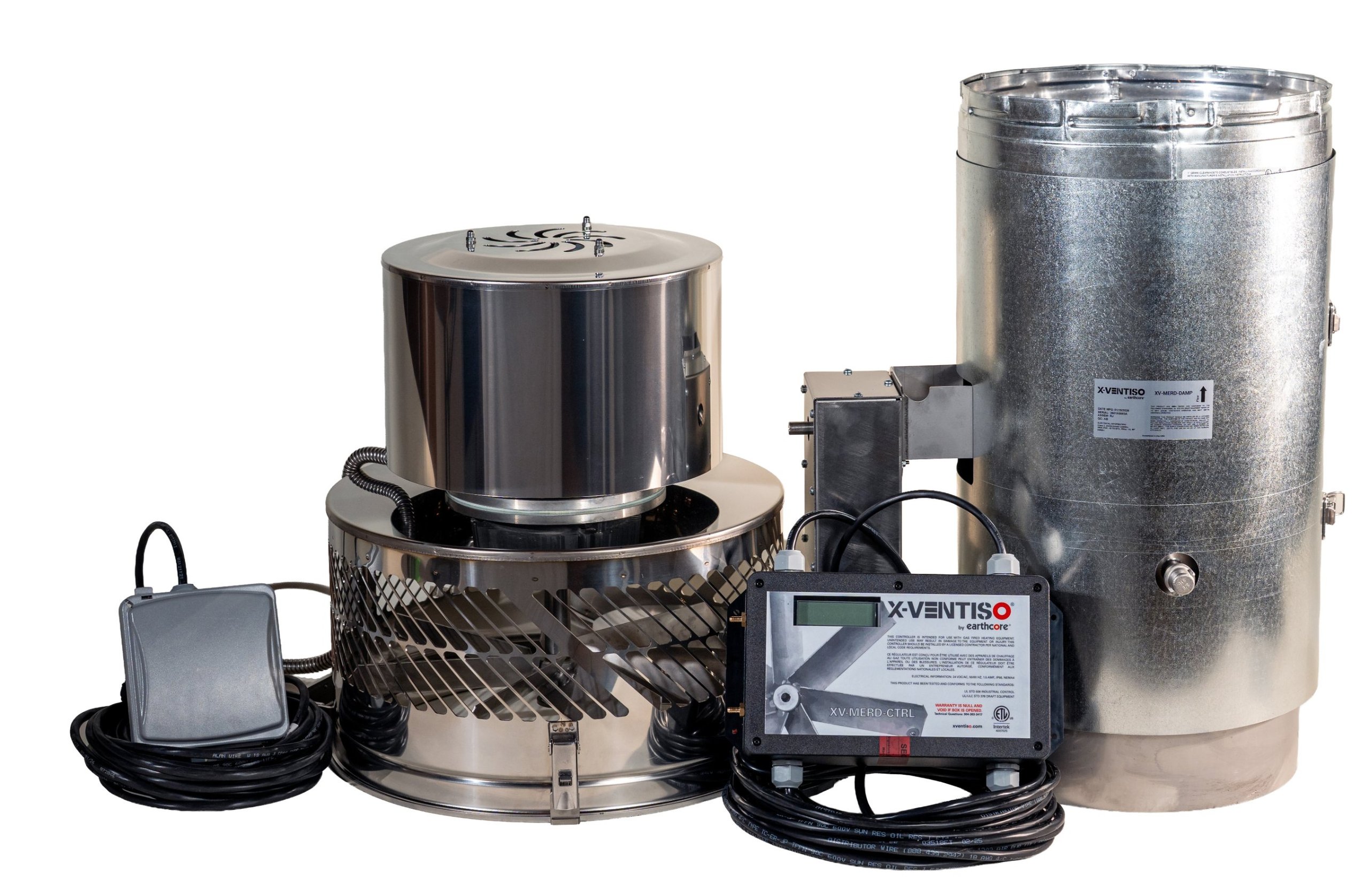
Exhale
XV Series + controls
Draft that holds against the room. Meridian modulates on gas; Controlled Power is set once for solid fuel.
XV Series and controls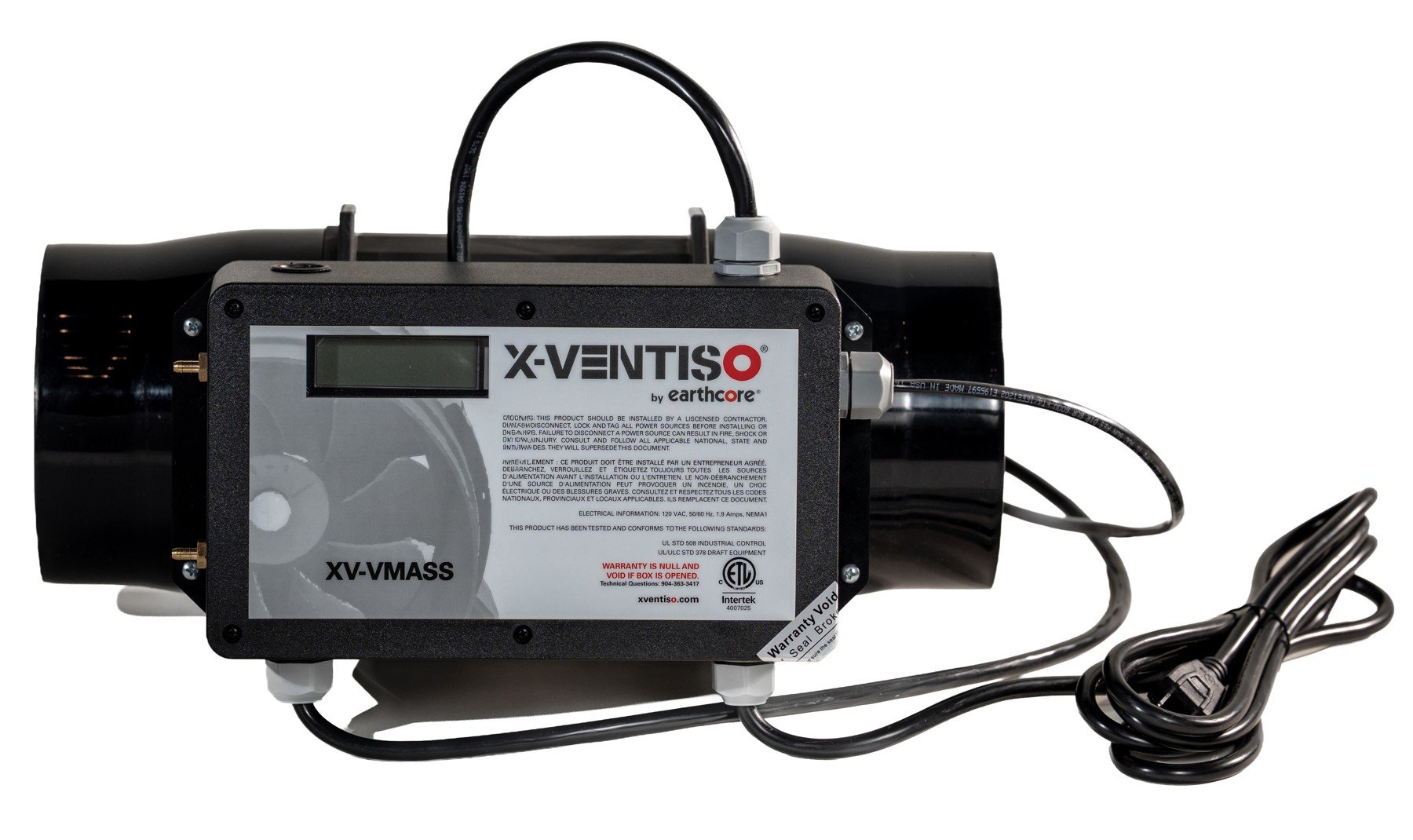
- Proves draft before the appliance lights
- Gas interlock or audible and visual alarm, by fuel
- Factory-wired Molex connections
- Plugs into a standard 120 V outlet
Proof
Code compliance
Every controller ships with what a code-compliant install requires. Systems, not parts.
What ships in every box
Common questions
What people ask us.
- Q.01Won't a draft inducer make the building more negative?
- A draft inducer moves the air a working chimney needs, not more. Controlled Power is set at commissioning to what that chimney needs, and Meridian adjusts to the room. The building still has to replace that air, along with everything the hood and dryer remove. That is the job of makeup air, and it is why we size the draft inducer and VMASS together.
- Q.02Why does the fireplace smell when it is off?
- When the building runs negative or the chimney is cold, air can flow down the flue instead of up, bringing chimney odor with it. On gas, a sealed automatic damper closes the flue when the fire is off and proves open before it lights. Makeup air keeps the building from pulling on the chimney in the first place.
- Q.03Is this only a wood-burning problem?
- No. Open gas fireplaces draft the same way and can spill the same way. Gas burns cleaner, so the signs are easier to miss: odor and stale air instead of visible smoke.
- Q.04How do I know before the fireplace goes in?
- An energy rater can run a worst-case depressurization test or a blower door test to show how negative the house gets with its exhaust equipment running. Or send us the plans, and we will size the draft and the makeup air for the zone before anything is built.